Where it started
In late 2019 or early 2020, a close friend and I were having a conversation that went, as many of ours did, something like this:
"Do you know this person?"
"No."
"What about this person?"
"No."
We each knew a lot of interesting, social people, and none of them knew each other. That's when I saw the gap. There were young diaspora Africans all over Greater Boston who looked like us, liked the same things and wanted the same things: good food, good music, somewhere to go and people to meet. What they didn't have was one place to find each other.
So I came up with The Mailing List: literally a list you could join to find out who was gathering and where. I named it, shaped the concept and wrote a short code of conduct that still governs the community today. My friend, TML's original co-founder, found our first venue and helped build the guest list. Twenty people came to a two-hour lunch in Boston. We made the introductions, made sure numbers got exchanged, and watched strangers find mutual friends. By the end, someone had bought shots for half the table. That's how we knew we were cooking with fire.
Shortly after, she moved away for medical school, I went back to grad school, and TML went quiet. For almost three years, I thought it was over.
The relaunch
In late 2022, a friend and I were planning a girls' night for five or six of us: drinks, and bole (roasted plantain) on the side. We invited a few friends, they invited a few of theirs, and before long, more than 60 people were in our two-bedroom apartment in Somerville. The demand had never gone away.
Afterwards, I said, "Let's reopen The Mailing List." We brought on a third friend and relaunched.
Who it was for
TML wasn't for everyone, and that was the point. It was for young diaspora Africans in Greater Boston who loved good food, good music, going out and meeting new people, and who wanted spaces that felt familiar without feeling like another party promotion.
Our whole thing was vibes, and we delivered on vibes. But vibes were the outcome of getting the details right for a very specific group of people.
How I built it
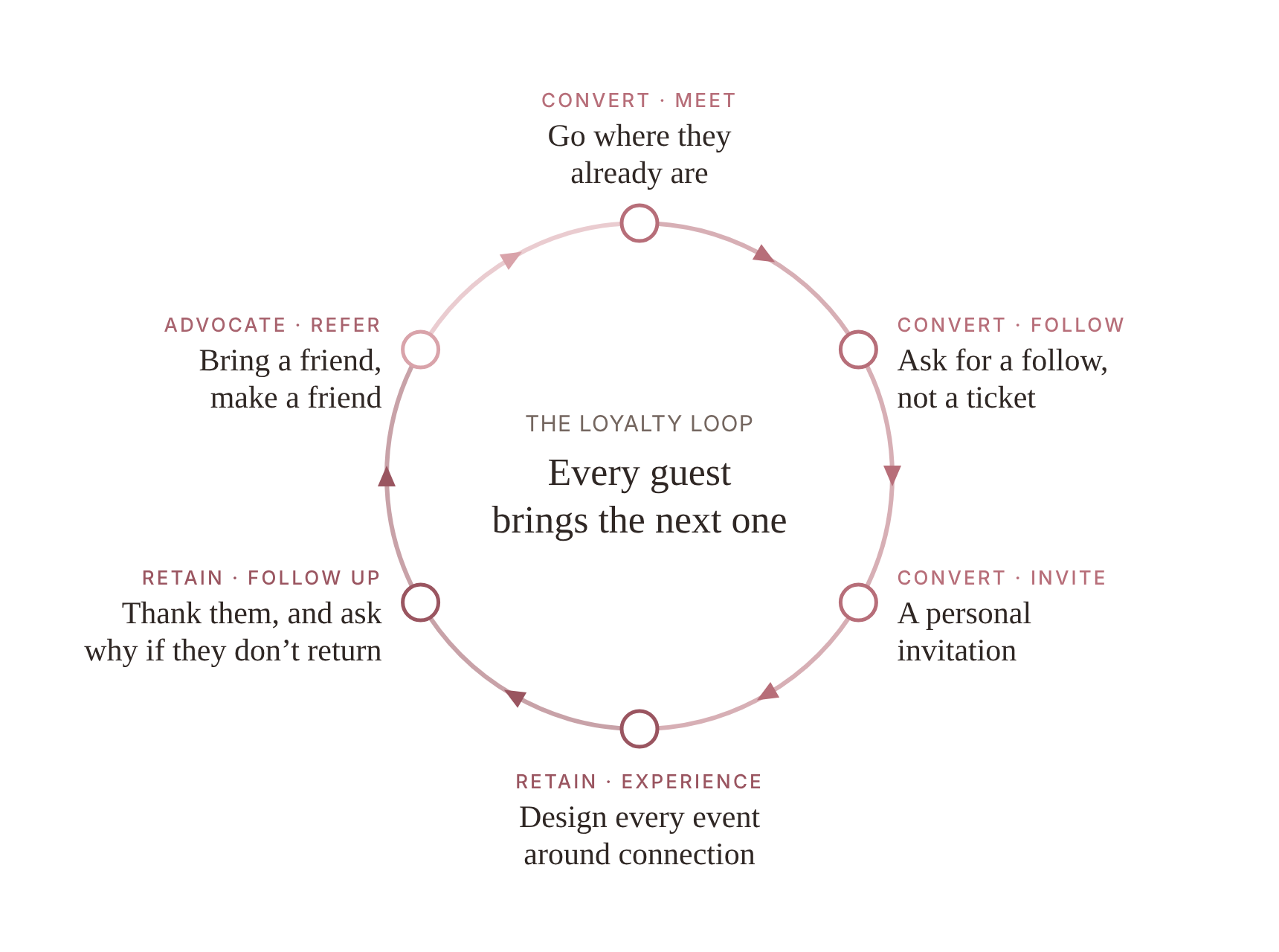
Looking back, TML ran on what I now call the loyalty loop: convert people into members, give them a reason to keep coming back, and turn them into the people who bring in the next guest.
Convert: getting people in
Make the first yes easy
I went where our people already were: parties, restaurants, clubs, community events. I went to enjoy myself, and when I met someone who was enjoying themselves too, I told them about TML. The ask was never "buy a ticket." It was "follow us." Both loving this event? Follow TML. Both hating it? Follow TML. And every time: tell your friends.
Treat a follow as the beginning
I noted where I'd met each person and followed up with a personal message: "It was great meeting you at…" When we announced events, we didn't just post them. We personally invited the people we wanted in the room, and if they couldn't make it, we told them we hoped to see them at the next one. People came because they felt wanted, not just informed.
Retain: making them want to come back
Design every event around connection
Every event was themed around things our community had told us they cared about, and a lot of it ran on nostalgia:
[swipe]
- Inter-house sports. Our annual flagship: a team field day based on the school sports days so many of us grew up with.
- Old-school breakfast. Built around the African breakfast foods we all missed.
- Dance parties. No agenda, no speeches. The only goal was to come and vibe.
- Friendsgiving potlucks. Everyone brought the food that meant the holidays to them.
There was always food, because people are happier when they're fed, and always really good music. We hosted mostly in people's homes so it felt intimate, and paid what you could through a give-as-you-see-fit model, so it never felt like a promotions company.
Host and listen at the same time
During every event, we circulated and spoke to everyone. It made people feel welcome and gave them an easy way in. It was also how we collected data: How did you hear about us? Have you been before? Who should we invite next time? We had that system long before we had the tools. After each event, everyone got a thank-you and a heads-up to watch for the next one.
Find out why people don't come back
If someone came once and didn't return, we wanted to know why. Too far? Too late? Wrong theme? Too crowded, or not crowded enough? Nobody they knew going? Then we designed around it. If 20 people skipped an event because it was too far, the next time we were close to them, they heard from us directly: "We're in your area this time. Bring a friend."
Give people something to take home
Every gathering came with something to take away: a to-go plate, a keychain, a wristband, a bandana, a sticker. They didn't need to be expensive. They needed to be memorable, so that finding one in a bag or a pocket weeks later brought TML right back to mind.
Keep the value going between events
TML didn't disappear between gatherings. Our group chat shared other events people might like, we did birthday shout-outs, and we found discounted tickets to outside events, so the community stayed useful even when we weren't hosting.
Protect the vibes
Our code of conduct came down to one rule: protect the vibes. No bigotry, no harassment, nothing that makes anyone feel unsafe, and drink responsibly. Break it, and you're off the list. Everyone saw it before they joined, so they were buying into it from day one, and we rarely had to step in.
Advocate: turning members into hosts
Bring a friend, make a friend
That was our mantra for most of TML's run. Bringing someone familiar made it easier to show up, and the expectation of meeting someone new gave people a reason to come back, even if a particular event wasn't their favorite. As we grew, we rewarded it with group discounts and, later, referral perks through our ticketing platform.
Let the community carry it
TML ran on community. Friends cooked, decorated, DJed and opened their homes, and members volunteered wherever we needed them. People helped carry it because it felt partly theirs.
Outcomes
- 20 to 300 returning members in 24 months, from the first lunch to an active membership base.
- About 80% repeat attendance, with most growth coming from members bringing friends.
- About 250 members in the group chat.
- 10 to 15 events between the relaunch and early 2025, about one every four to six weeks, the largest with more than 100 guests.
- No paid advertising. Growth came from outreach, personal invitations, referrals and community.
What I learned
[swipe]
- Know exactly who you're serving. Being specific is what made people feel recognized.
- Make the first yes easy. A follow was easier than a ticket, and it opened the door to everything else.
- People remember being remembered. Personal follow-up turned followers into guests.
- Retention starts with listening. The people who didn't come back taught me as much as the ones who did.
- Write the culture down. A clear code of conduct protected the experience as we grew.
- The system comes before the software. Tools helped us scale what we were already doing by hand.
Stepping away
I stepped away from The Mailing List at the start of 2025. The brand has kept growing, and its direction now belongs to the people carrying it forward.
What I can speak to is the foundation: the idea, the name, the first gathering, the relaunch, the growth and retention systems, the events and the culture. I'm proud that it became bigger than a single lunch, and eventually bigger than me.
TML taught me that conversion and retention aren't abstract business functions. They come from understanding who people are, making it easy for them to come in, giving them an experience worth repeating, remembering them afterwards and giving them a reason to return. That's the work I keep doing, whether the community is built around an event, a service, a property or a brand.