Case file
Parking Operations
Building a parking program from the ground up for a 200-unit community. Today, about 97% of resident vehicles are on record and guest requests run on their own.
The problem
A 200-unit apartment community had no clearly defined parking system. There were no guest parking rules and no reliable vehicle registry, so there was no way to know which cars were authorized to be on site. Unpaid vehicles went unnoticed, rules were applied inconsistently, and complaints from residents and visitors kept coming in.
What looked like a day-to-day nuisance was really an operational gap, and it was costing the property revenue and resident trust. I took ownership of building a parking program from the ground up.
The solution
Consolidating records
With no registry to work from, I combed through leasing records for all 200+ units and consolidated resident names, vehicle details and parking tiers into one registry. Each confirmed vehicle was linked to its parking tier and monthly charge. Seeing everything in one place exposed mismatches between who was parking and who was paying.
Building a strategy
I evaluated the available parking inventory to decide how to split it between residents and guests. That confirmed we could accommodate visitor parking on site, and we designated dedicated visitor spaces. From there, I designed and procured numbered hang tags for residents and guests, so staff could see at a glance that a car was registered and its charges were accounted for.
Have the hang tags numbered during production. It would have cost nothing extra and made it easy to track distribution and tie each tag to a vehicle owner. Instead, I spent weeks labeling them by hand.
Designing the system
I built a new policy and approval logic from the community's existing rules on overnight guests and on-site parking, weighed against how much management could realistically enforce. Guest parking runs on reservations to protect the limited inventory, with a maximum number of nights per request, a time-based cutoff for overnight requests, and overflow accommodation when visitor spaces are full.
Residents submit a request at any time of day. It's checked against the rules and they get an approval or denial right away, with a printable pass, even when the office is closed.
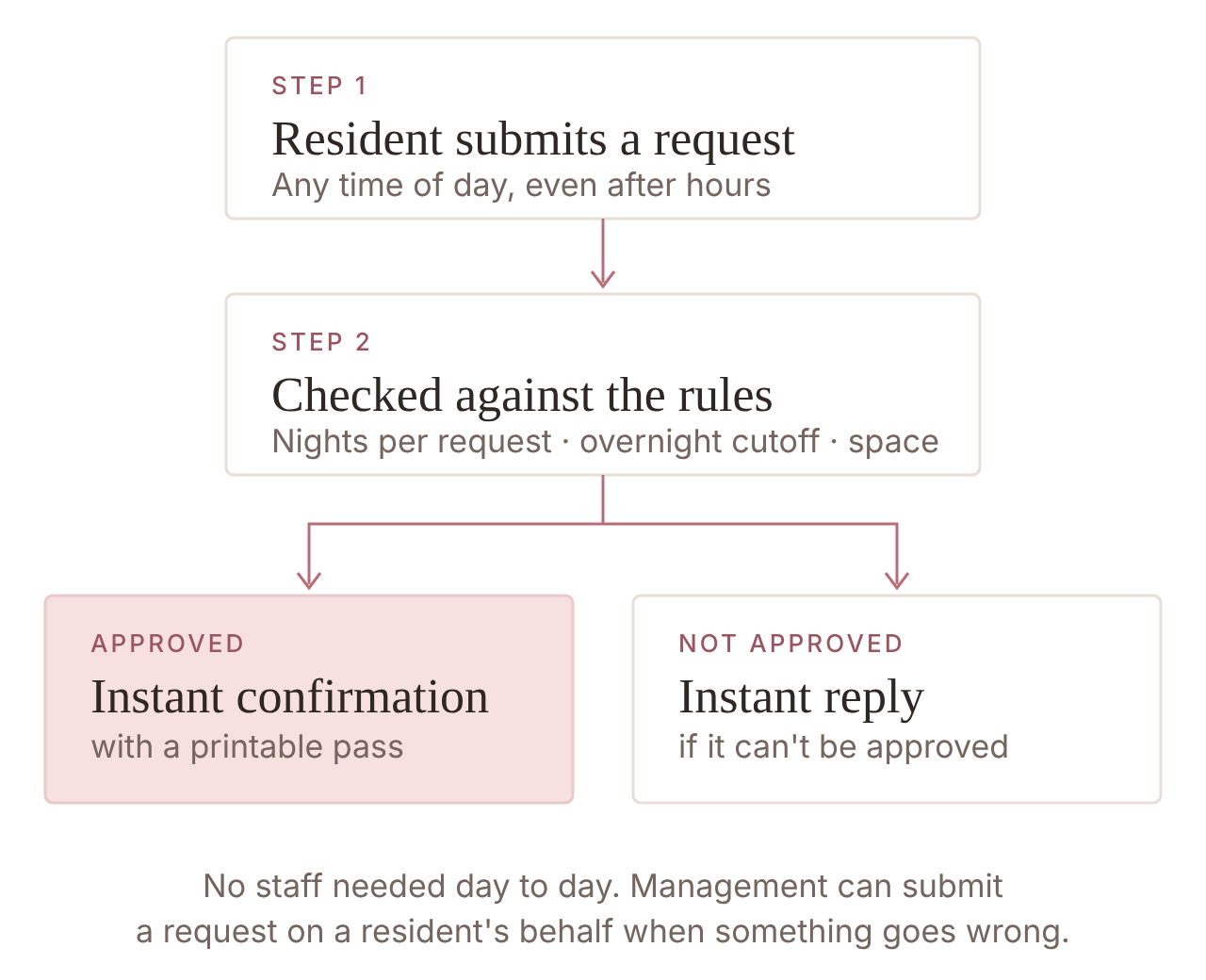
The system was built entirely in Microsoft 365, using mail merge and Power Automate.
Implementation
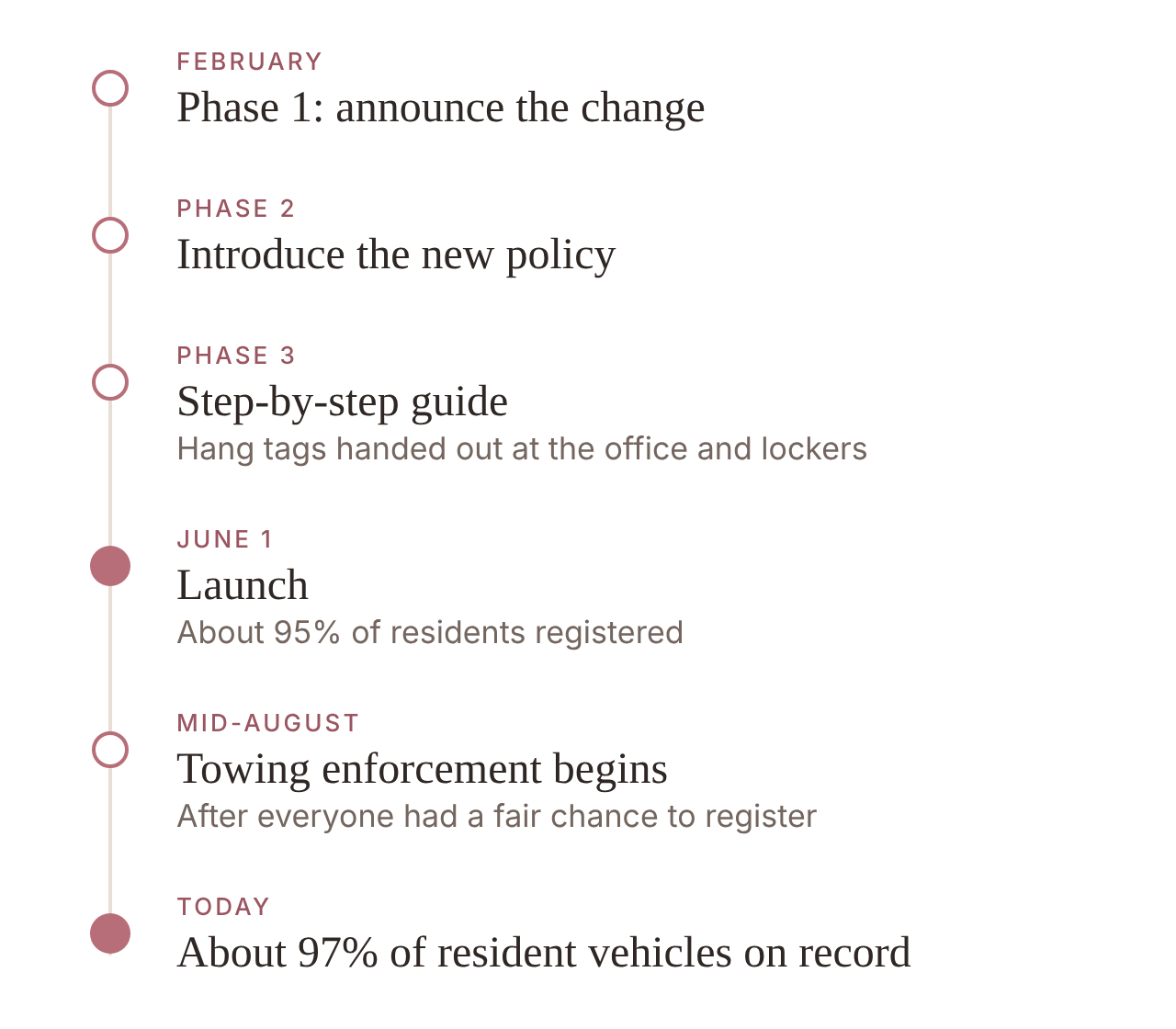
I rolled out communications by email in three phases, so residents had time to adjust without being overwhelmed: announcing the change, introducing the policy, then a step-by-step guide to what was expected of them. Each phase came with reminders. Tags were handed out through the office and, on request, the package lockers, and parking guidance went into move-in materials so new residents knew the rules from day one.
Starting in February, we reached about 95% adoption by the June 1 launch.
Enforcement
Once adoption cleared our target, measured by tags issued against vehicles recorded, we marked the visitor spaces with signage, then line striping, which I folded into already budgeted work at no added cost. Towing enforcement started in mid-August, once residents had a fair chance to register.
I revised the agreement with our towing vendor to enforce the new system. When they struggled to apply it in real time, I paused enforcement and sourced a new vendor better suited to the program.
Bring vendors in early. New operations can't always be supported by the partners already in place, and when a vendor can't adapt, it costs the business money. Aligning on rules, timing and verification before launch would have saved us the switch.
Outcomes
- About 5% more in parking charges per occupied unit, even with fewer units occupied, once every vehicle was matched to its charge.
- 130 guest requests handled automatically in the first 120 days, without staff reviewing each one, including after hours.
- About 95% adoption by launch. Every move-in since August has been tagged, so about 97% of resident vehicles are now on record.
- Up to 25 guest vehicles accommodated at once when space allows, through overflow into eligible outdoor parking.
- There now existed for ongoing use by management:
- A Designated guest parking system
- Clearer policy surrounding use
- Consistent parking guidance across posted signage, digital resident communications and move-in materials.
Management and monitoring
Before handing the project off, I also managed its shortfalls:
- Vendor recovery. I handled service recovery from the first towing vendor's mistakes and reconciled the revenue lost.
- Input errors. Gave management the ability to submit requests on residents' behalf when entry mistakes broke the automation.
- Tag tracking. Lost tags and inconsistent distribution left some gaps in the registry that needed patching up.
- Compliance issues stemmed in large part due to confusion. I designed and added maps to resident documents and created an accessible digitized policy summary.
- I also built out a full resident handbook and newsletter to support future updates.
What next?
The next phase is less about adding policy and more about simplifying enforcement and reducing friction:
- Find a way to synchronize information delivery of authorized vehicles belonging to residents, and guests, to the new towing partner, so they can verify a car before removing it.
- Define team roles as the system grows, so responsibility isn't ad hoc and records can be better reconciled.
- Automate further so the approved request can replace the need for a physical tag, reducing compliance friction.
I've since explored that last idea further in Curbwyse, a guest parking app I built out and demoed:(link "Curbwyse" to: /curbwyse-demo.html)